CKS인증시험덤프는Certified Kubernetes Security Specialist (CKS)시험을단번에패스하는필수자료
Wiki Article
참고: Itcertkr에서 Google Drive로 공유하는 무료 2026 Linux Foundation CKS 시험 문제집이 있습니다: https://drive.google.com/open?id=1ioPWIZQODgNSMRqmVfYBkEKxk6xvY55q
Itcertkr의 Linux Foundation인증 CKS덤프를 구매하시면 1년동안 무료 업데이트서비스버전을 받을수 있습니다. 시험문제가 변경되면 업데이트 하도록 최선을 다하기에Itcertkr의 Linux Foundation인증 CKS덤프의 유효기간을 연장시켜드리는 셈입니다.퍼펙트한 구매후는 서비스는Itcertkr의 Linux Foundation인증 CKS덤프를 구매하시면 받을수 있습니다.
Linux Foundation CKS (Certified Kubernetes Security Specialist) 인증 시험은 컨테이너화 된 응용 프로그램 및 Kubernetes 플랫폼 보안에 대한 개인의 기술과 지식을 검증하는 업계 인식 인증입니다. 이 시험은 Kubernetes 및 Containization에 대한 경험이 있고 안전한 컨테이너 오케스트레이션에 대한 전문 지식을 보여줌으로써 경력을 발전시키려는 전문가를 위해 설계되었습니다. 인증은 고용주의 가치가 높으며 전문가가 자신의 전문 지식을 보여주고 분야의 다른 사람들과 차별화하는 훌륭한 방법입니다.
CKS적중율 높은 덤프 - CKS높은 통과율 시험대비 덤프공부
Linux Foundation인증CKS시험의자격증은 여러분에 많은 도움이 되리라 믿습니다. 하시는 일에서 한층 더 업그레이드될 것이고 생활에서도 분명히 많은 도움이 될 것입니다. 자격증취득 즉 재산을 얻었죠.Linux Foundation인증CKS시험은 여러분이 it지식테스트시험입니다. Itcertkr에서는 여러분의 편리를 위하여 Itcertkr만의 최고의 최신의Linux Foundation CKS덤프를 추천합니다. Itcertkr를 선택은 여러분이 최고의 선택입니다. Itcertkr는 제일 전면적인Linux Foundation CKS인증시험자료의 문제와 답을 가지고 잇습니다.
CKS 자격증 시험은 Kubernetes 아키텍처와 보안 개념에 대한 견고한 이해를 가진 전문가들을 대상으로합니다. 또한 그들의 조직에서 Kubernetes 클러스터를 보호하는 책임을 지고 있는 사람들에게 이상적입니다. 시험은 Kubernetes 설치 및 구성, 네트워크 보안, 액세스 관리 및 Kubernetes 클러스터 강화 등 다양한 주제를 다룹니다. 시험은 후보자가 Kubernetes 환경에서 보안 위협을 식별하고 완화하기 위한 능력을 테스트하기 위해 설계되었습니다.
CKS 인증 시험은 고용주들에게 높이 평가되는 산업 인증서입니다. 이는 전문가들이 Kubernetes 배포를 보호하고 최신 보안 모범 사례를 따르기 위한 전문성을 입증하는 방법입니다. 이 인증서는 Kubernetes 클러스터를 보호하고 민감한 데이터를 보호하는 데 도움을 줄 수 있는 자격을 갖춘 전문가를 식별하는 기업들에게도 유용합니다.
최신 Kubernetes Security Specialist CKS 무료샘플문제 (Q65-Q70):
질문 # 65
A container image scanner is set up on the cluster.
Given an incomplete configuration in the directory
/etc/Kubernetes/confcontrol and a functional container image scanner with HTTPS endpoint https://acme.local.8081/image_policy
- A. 1. Enable the admission plugin.
정답:A
설명:
2. Validate the control configuration and change it to implicit deny.
Finally, test the configuration by deploying the pod having the image tag as the latest.
질문 # 66
Your organization has a policy requiring all Kubernetes deployments to utilize Pod Security Policies (PSPs) to enforce security best practices. You're responsible for creating a PSP that enforces the following:
- Only allows containers with a specific security context (privileged: false, runAsUser: 1000, readOnlyRootFilesystem: true)
- Restricts access to most resources by denying the 'hostPort and 'hostNetwork' capabilities.
- Prohibits the use of privileged containers.
Implement the required PSP configuration
정답:
설명:
Solution (Step by Step) :
1. Create a PodSecurityPolicy:
- Define a PodSecurityP01icy named 'secure-policy' that enforces the specified security restrictions.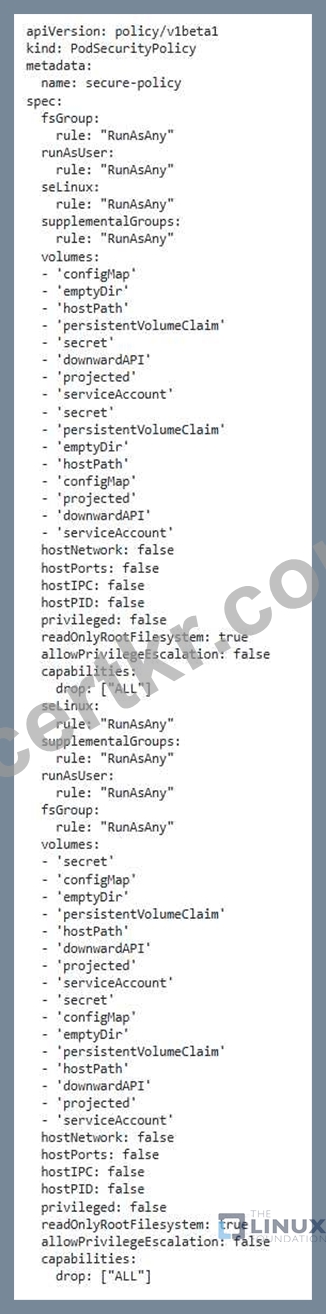
2. Create a PodSecurityPolicy8inding: - Bind the 'secure-policy' to a namespace or specific deployments. - This ensures that the PSP is enforced for deployments Within the bound scope.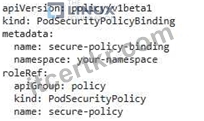
3. Deploy the PSP: - Apply the 'secure-policy.yaml and 'secure-policy-binding.yaml files to the cluster - This will activate the PSP and enforce the defined security rules. 4. Validate PSP Enforcement - Attempt to create a deployment that violates the PSP rules. - Verifry that the deployment creation fails due to the PSP enforcement.
질문 # 67
You are tasked with ensuring the security of a Kubernetes cluster running a sensitive application. Describe now you would implement a "least privilege" principle for both users and service accounts in this cluster.
정답:
설명:
Solution (Step by Step) :
1. User Roles and Permissions:
- Define specific roles with minimal permissions for different user groups based on their responsibilities.
- For example, developers might have access to deploy applications, while operations team members might have access to manage resources.
- use RBAC (Role-Based Access Control) in Kubemetes to define roles and assign them to users.
2. Service Account Permissions:
- Create separate service accounts for each application or service in the cluster.
- Grant the service accounts only the necessary permissions to perform their specific tasks.
- Avoid using default service accounts with broad permissions.
- Employ the "principle ot least privilege" by defining minimal permissions for service accounts.
3. Pod Security Policies (PSPs):
- Implement PSPs to enforce security constraints on pods, restricting resources that they can access.
- Define PSPs to allow only specific container images, disable privileged containers, limit resource requests, and enforce other security controls.
- Consider using Pod Security Admission (PSA) as a replacement for PSPs in Kubernetes 1.25+.
4. Network Policies:
- Implement network policies to control network communication between pods and services.
- Define rules that allow only necessary traffic between pods, restricting any unnecessary or unauthorized connections.
5. Secret Management
- Utilize Kubernetes Secrets to store sensitive information like passwords and API keys.
- Limit access to secrets based on the principle of least privilege.
- Avoid storing sensitive information directly in deployment YAML files.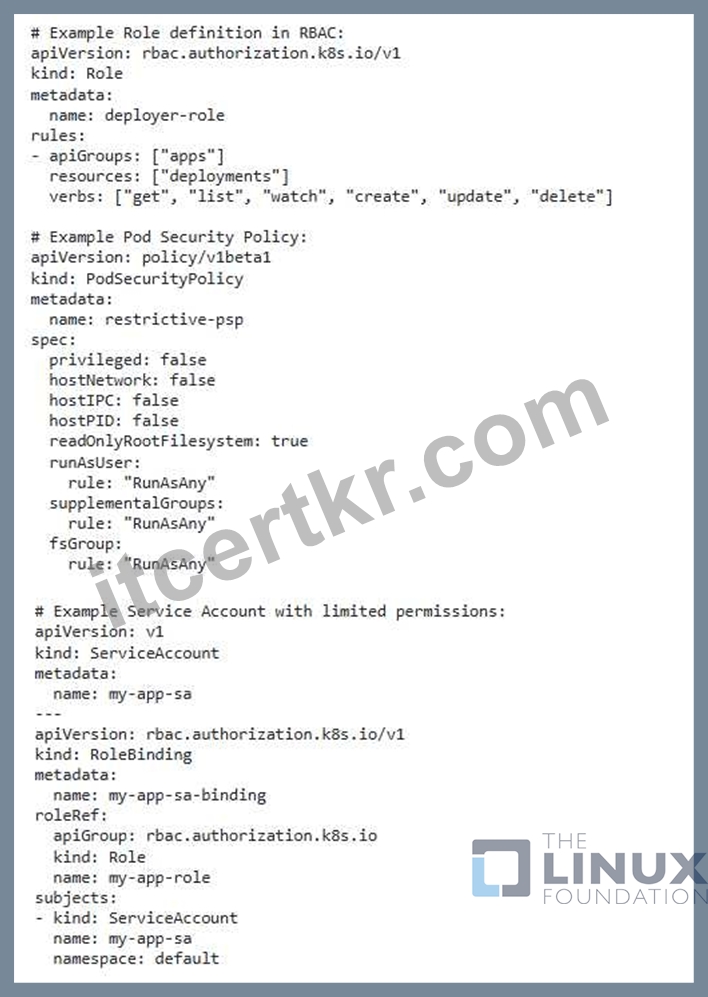
질문 # 68
You are running a Kubernetes cluster in AWS with a workload that involves sensitive data processing. You suspect that some of your pods might be compromised and are leaking data to an external server. You need to identify the compromised pods and isolate them from the network. Explain the steps you would take to achieve this, including the tools and techniques you would use to monitor network traffic, identify suspicious activity, and isolate compromised pods.
정답:
설명:
Solution (Step by Step):
1. Enable Network Policy: Start by enabling network policies in your Kubernetes cluster. This will restrict network traffic between pods based on predefined rules.
Implementation: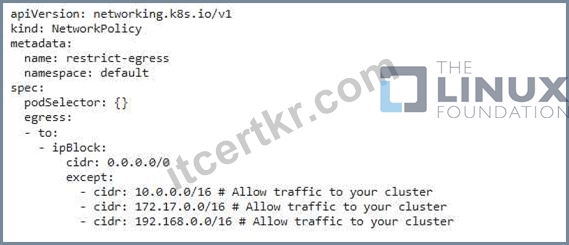
2. Monitor Network Traffic with tools like: Kubernetes Network Policy: Analyze the network policies configured on your cluster to identify any potentially suspicious traffic patterns. Kube-Proxy: Use 'kubectl proxy' to monitor the network traffic within your cluster. Observe incoming and outgoing traffic to identify any unusual patterns. Network Security Monitoring Tools: Consider using dedicated network security monitoring tools like Suricata, Zeek, or tcpdump for more comprehensive network analysis. Implementation: bash kubectl proxy --port=8001 # Start kubectl proxy # In a separate terminal, run the following command to view traffic to a specific pod: curl -v http://localhost.'8001/api/v1/namespaces/default/pods//proxy/ # Analyze the output to identify suspicious traffic. 3. Analyze Logs for Suspicious Activity: Kubernetes Logs: I-Ise tools like ' kubectl logs to inspect the logs of your pods, especially those related to data processing. Look for signs of unauthorized access, data exfiltration attempts, or unusual activity patterns. Security Logging: Configure your cluster to collect security-related events and logs in a centralized logging system like Elasticsearch, Fluentd, and Kibana (EFK) stack. Security Monitoring Tools: Employ tools like Falco or Auditd to actively monitor and analyze security-related events within your Kubernetes cluster. Implementation: bash kubectl logs -f # View logs of the pod 4. Isolate Compromised Pods: Network Segmentation: Use network policies to restrict the network access of suspected pods. Pod Disruption Budget (PDB): Ensure that your workload doesn't become unavailable during the isolation process. Service Disruption: If the compromised pod belongs to a service, consider temporarily removing it from the service's endpoint list to isolate the compromised service instance. Implementation: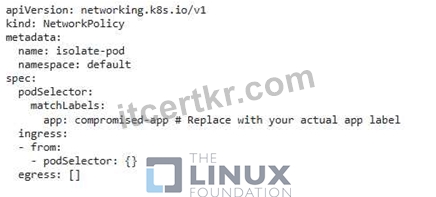
5. Investigate and Remediate: Root Cause Analysis: Once the compromised pod is isolated, perform a thorough analysis to determine the cause of the compromise. This may involve examining system logs, network traffic, and potentially performing forensic analysis on the compromised pod Security Remediation: Address the root cause of the compromise by patching vulnerabilities, updating security configurations, and nardening your systems. Recovery and Restoration: If necessary, recover data that may have been leaked and restore your system to a secure state. Implementation: bash # Investigate the cause of the compromise: kubectl logs -f # Analyze the network traffic related to the pod using kubectl proxy and network monitoring tools. # Remediate the compromise: kubectl delete pod # Replace with the name of the compromised pod # Update security configurations # Patch vulnerabilities # Consider using a new container image with updated security measures # Restore data if necessary
질문 # 69
Context:
Cluster: prod
Master node: master1
Worker node: worker1
You can switch the cluster/configuration context using the following command:
[desk@cli] $ kubectl config use-context prod
Task:
Analyse and edit the given Dockerfile (based on the ubuntu:18:04 image)
/home/cert_masters/Dockerfile fixing two instructions present in the file being prominent security/best-practice issues.
Analyse and edit the given manifest file
/home/cert_masters/mydeployment.yaml fixing two fields present in the file being prominent security/best-practice issues.
Note: Don't add or remove configuration settings; only modify the existing configuration settings, so that two configuration settings each are no longer security/best-practice concerns.
Should you need an unprivileged user for any of the tasks, use user nobody with user id 65535
정답:
설명:
1. For Dockerfile: Fix the image version & user name in Dockerfile
2. For mydeployment.yaml : Fix security contexts
Explanation
[desk@cli] $ vim /home/cert_masters/Dockerfile
FROM ubuntu:latest # Remove this
FROM ubuntu:18.04 # Add this
USER root # Remove this
USER nobody # Add this
RUN apt get install -y lsof=4.72 wget=1.17.1 nginx=4.2
ENV ENVIRONMENT=testing
USER root # Remove this
USER nobody # Add this
CMD ["nginx -d"]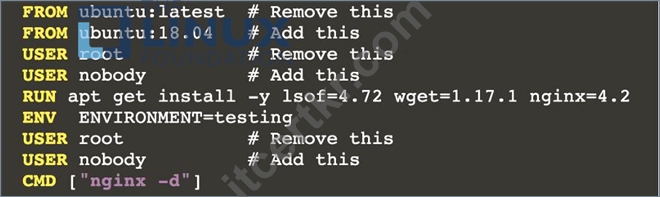
[desk@cli] $ vim /home/cert_masters/mydeployment.yaml
apiVersion: apps/v1
kind: Deployment
metadata:
creationTimestamp: null
labels:
app: kafka
name: kafka
spec:
replicas: 1
selector:
matchLabels:
app: kafka
strategy: {}
template:
metadata:
creationTimestamp: null
labels:
app: kafka
spec:
containers:
- image: bitnami/kafka
name: kafka
volumeMounts:
- name: kafka-vol
mountPath: /var/lib/kafka
securityContext:
{"capabilities":{"add":["NET_ADMIN"],"drop":["all"]},"privileged": True,"readOnlyRootFilesystem": False, "runAsUser": 65535} # Delete This
{"capabilities":{"add":["NET_ADMIN"],"drop":["all"]},"privileged": False,"readOnlyRootFilesystem": True, "runAsUser": 65535} # Add This resources: {} volumes:
- name: kafka-vol
emptyDir: {}
status: {}
Pictorial View:
[desk@cli] $ vim /home/cert_masters/mydeployment.yaml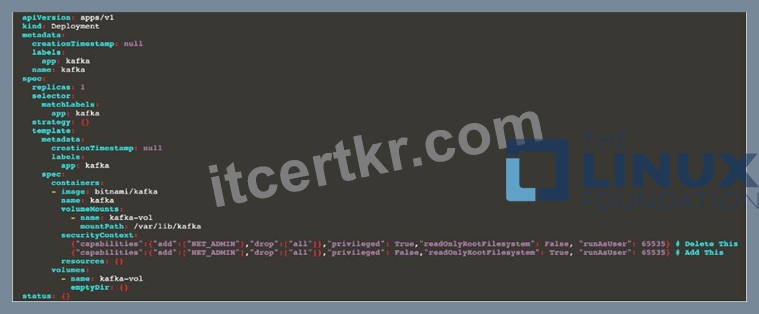
질문 # 70
......
CKS적중율 높은 덤프: https://www.itcertkr.com/CKS_exam.html
- CKS인증시험 시험 최신버전 덤프자료 다운 ???? [ www.koreadumps.com ]을 통해 쉽게⏩ CKS ⏪무료 다운로드 받기CKS적중율 높은 인증시험덤프
- CKS인증시험 - 높은 통과율 Certified Kubernetes Security Specialist (CKS)적중율 높은 덤프 덤프로 시험에 패스하여 자격증 취득하기 ???? 시험 자료를 무료로 다운로드하려면▷ www.itdumpskr.com ◁을 통해⏩ CKS ⏪를 검색하십시오CKS시험대비 인증덤프
- CKS인증시험 완벽한 시험 최신 기출문제 ☑ 오픈 웹 사이트{ www.pass4test.net }검색➽ CKS ????무료 다운로드CKS시험대비 최신버전 덤프샘플
- CKS인증시험 완벽한 시험 최신 기출문제 ???? 「 www.itdumpskr.com 」웹사이트를 열고《 CKS 》를 검색하여 무료 다운로드CKS최고품질 인증시험자료
- CKS인증시험 - 높은 통과율 Certified Kubernetes Security Specialist (CKS)적중율 높은 덤프 덤프로 시험에 패스하여 자격증 취득하기 ???? 무료 다운로드를 위해“ CKS ”를 검색하려면⮆ www.passtip.net ⮄을(를) 입력하십시오CKS유효한 최신덤프공부
- CKS인증시험 - 높은 통과율 Certified Kubernetes Security Specialist (CKS)적중율 높은 덤프 덤프로 시험에 패스하여 자격증 취득하기 ???? 오픈 웹 사이트⏩ www.itdumpskr.com ⏪검색[ CKS ]무료 다운로드CKS최신 인증시험
- CKS인증시험 퍼펙트한 덤프의 문제를 마스터하면 시험합격 가능 ???? { www.koreadumps.com }에서 검색만 하면( CKS )를 무료로 다운로드할 수 있습니다CKS최고품질 인증시험자료
- 100% 합격보장 가능한 CKS인증시험 인증시험 덤프자료 ???? ➡ www.itdumpskr.com ️⬅️을 통해 쉽게▶ CKS ◀무료 다운로드 받기CKS최고패스자료
- CKS인증시험 시험 최신버전 덤프자료 다운 ???? 지금【 www.dumptop.com 】을(를) 열고 무료 다운로드를 위해{ CKS }를 검색하십시오CKS퍼펙트 최신 공부자료
- CKS적중율 높은 인증시험덤프 ???? CKS인증공부문제 ???? CKS자격증참고서 ???? ➽ www.itdumpskr.com ????의 무료 다운로드➠ CKS ????페이지가 지금 열립니다CKS시험덤프샘플
- CKS인증시험 - 높은 통과율 Certified Kubernetes Security Specialist (CKS)적중율 높은 덤프 덤프로 시험에 패스하여 자격증 취득하기 ???? ▷ www.dumptop.com ◁에서➠ CKS ????를 검색하고 무료 다운로드 받기CKS최신 인증시험
- blancheuxed324600.bloggazza.com, kallummbho041021.wikigop.com, bushrattub498266.mdkblog.com, donnaerrf919373.mdkblog.com, www.stes.tyc.edu.tw, heathebni223091.activoblog.com, bookmark-share.com, getidealist.com, www.stes.tyc.edu.tw, idasmbm777450.livebloggs.com, Disposable vapes
그 외, Itcertkr CKS 시험 문제집 일부가 지금은 무료입니다: https://drive.google.com/open?id=1ioPWIZQODgNSMRqmVfYBkEKxk6xvY55q
Report this wiki page